Ground improvement in Boise represents a critical branch of geotechnical engineering that transforms marginally suitable soils into reliable, load-bearing strata for construction. This category encompasses a suite of specialized techniques—from deep mixing and jet grouting to dynamic compaction and preloading—designed to enhance the engineering properties of the ground. In Idaho's capital, where rapid urban expansion meets variable subsurface conditions, these methods are not optional luxuries but essential prerequisites for safe, durable infrastructure. Whether supporting a new mid-rise in downtown Boise or a warehouse near the Boise Airport, the ability to modify soil behavior underpins project feasibility and long-term performance.
The Treasure Valley's geology presents a complex mosaic shaped by the Boise River, ancient Lake Idaho sediments, and Quaternary alluvial deposits. Much of the city sits on interbedded sands, silts, and clays with lenses of gravel, often accompanied by shallow groundwater tables in areas near the river and its tributaries. Loose alluvial sands susceptible to liquefaction, soft compressible clays prone to settlement, and collapsible silts in the upper foothills demand careful characterization. These conditions, typical of fluvial and lacustrine environments, can lead to differential settlement, bearing capacity failures, or seismic instability if left unaddressed. A thorough understanding of unsaturated soil behavior is often the starting point for designing effective interventions, and our unsaturated soil analysis service provides the necessary framework for evaluating moisture-sensitive deposits common to the region.
Regulatory compliance in Boise falls under the International Building Code (IBC) as adopted by the State of Idaho, supplemented by local amendments from the City of Boise's Public Works Department. Geotechnical investigations must follow Idaho Board of Professional Engineers and Professional Land Surveyors standards, with reports sealed by a licensed professional engineer. For seismic design, ASCE 7-22 provisions govern ground motion parameters based on the National Seismic Hazard Maps, which classify portions of the valley as Site Class D or E due to soft soil amplification. Projects involving fill placement or slope modification must also adhere to the Idaho Department of Environmental Quality's stormwater and erosion control regulations, particularly within the Boise River floodplain where groundwater protection is paramount.
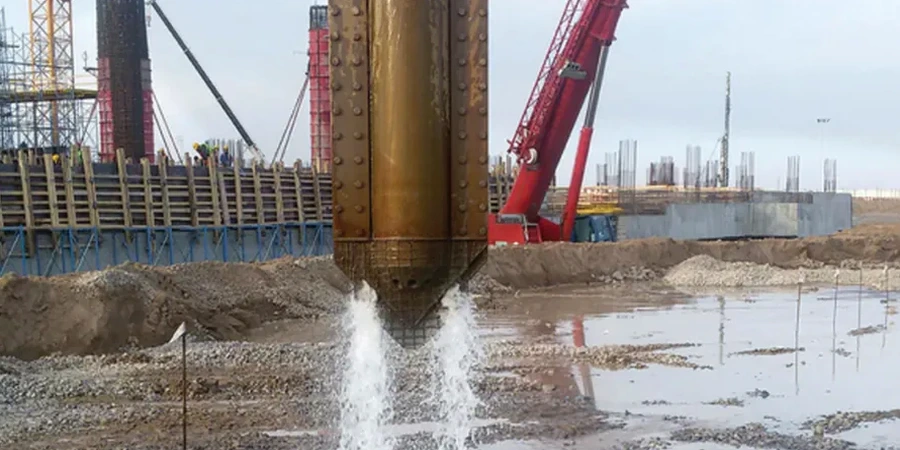
The types of projects requiring ground improvement in Boise are diverse. Commercial developments on former agricultural land often encounter compressible clays needing preloading design to accelerate consolidation before foundation construction. Large-footprint warehouses and distribution centers benefit from dynamic compaction design to densify loose granular fills efficiently. Infrastructure corridors, including road widenings and utilities, increasingly turn to deep soil mixing to create stiff, low-permeability columns that control settlement and improve slope stability. For sites with contaminated soils or complex stratigraphy, jet grouting design offers precision treatment in difficult access conditions. Each technique must be matched to the specific subsurface profile and performance requirements.
Available services
Unsaturated soil analysis
→ Ver detalleDynamic compaction design
→ Ver detalleDeep Soil Mixing (DSM) design
→ Ver detalleJet grouting design
→ Ver detallePreloading design (without surcharge)
→ Ver detallePreloading with surcharge design
→ Ver detalleVibrocompaction design
→ Ver detalleGeomembrane specification
→ Ver detalleLime and cement stabilization
→ Ver detalleGeotechnical instrumentation (design and installation)
→ Ver detalleOrganic soil management
→ Ver detalleCommon questions
What is ground improvement and when is it necessary in Boise?
Ground improvement refers to a set of geotechnical techniques that modify in-situ soils to increase strength, reduce compressibility, or mitigate liquefaction risk. In Boise, it becomes necessary when alluvial sands, soft clays, or collapsible silts cannot safely support proposed structures, as determined by a geotechnical investigation.
How do Boise's soil conditions influence the choice of ground improvement method?
Boise's interbedded sands, silts, and clays with shallow groundwater require method-specific design. Loose granular soils may respond well to vibrocompaction or dynamic compaction, while soft clays often need deep soil mixing or preloading. A site-specific unsaturated soil analysis guides selection in moisture-sensitive deposits.
What regulations govern ground improvement work in Boise?
Work must comply with the Idaho-adopted International Building Code, local Boise Public Works amendments, and ASCE 7-22 seismic standards. Geotechnical reports require a sealed professional engineer's stamp, and projects near the Boise River must meet Idaho DEQ erosion and groundwater protection rules.
How long does ground improvement typically take for a commercial project?
Duration varies widely by method and soil conditions. Dynamic compaction or vibrocompaction may complete in days to weeks, while preloading with surcharge can require several months to achieve primary consolidation. Deep mixing and jet grouting offer intermediate timelines, depending on treatment volume and access.